
DefenceApr 1, 2025
Tactical Power Management for Military Ops
Modern military operations demand smarter power management. Hydrogen fuel cells reduce logistics burden, noise, and thermal signature in the field.
5 min read
Power Is a Tactical Liability When Managed Poorly
Every piece of equipment a soldier carries, every sensor on a vehicle, every communications relay at a forward operating base needs electricity. Power management in military operations is not an afterthought. It is a planning factor that drives logistics, operational security, and mission capability.
Poor power management creates noise that compromises positions, heat signatures that attract targeting, fuel convoys that expose personnel to ambush, and equipment failures at the worst possible moments. Modern hydrogen fuel cell technology addresses every one of these vulnerabilities.
The Military Power Problem
Modern soldiers carry 20-30 lbs of batteries for a 72-hour mission. Radios, GPS units, night vision, tactical computers, weapon optics, and electronic warfare systems all demand power. That weight competes directly with ammunition, water, food, and protective equipment.
At the operational level, fuel logistics is even more problematic.
Fuel Convoy Vulnerability
The U.S. Army estimates that one casualty occurs for every 24 fuel convoys in contested environments. Any reduction in convoy requirements directly saves lives.
Tactical Power Hierarchy
Effective tactical power management layers solutions by echelon:
Individual Soldier
The soldier needs power for personal electronics: radio, GPS, NVGs, weapon optics. Current solutions rely on heavy lithium batteries that must be recharged or replaced frequently.
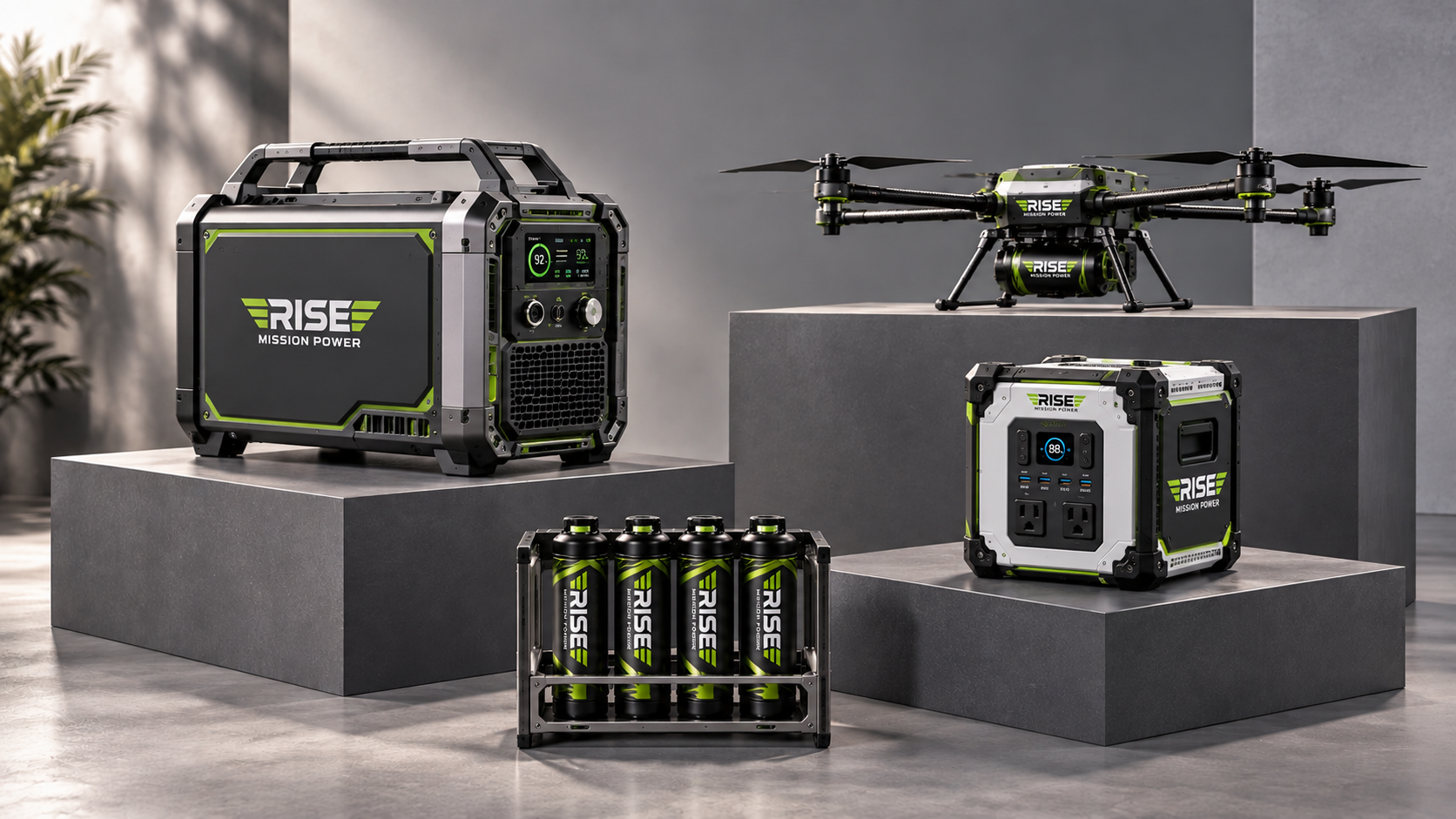
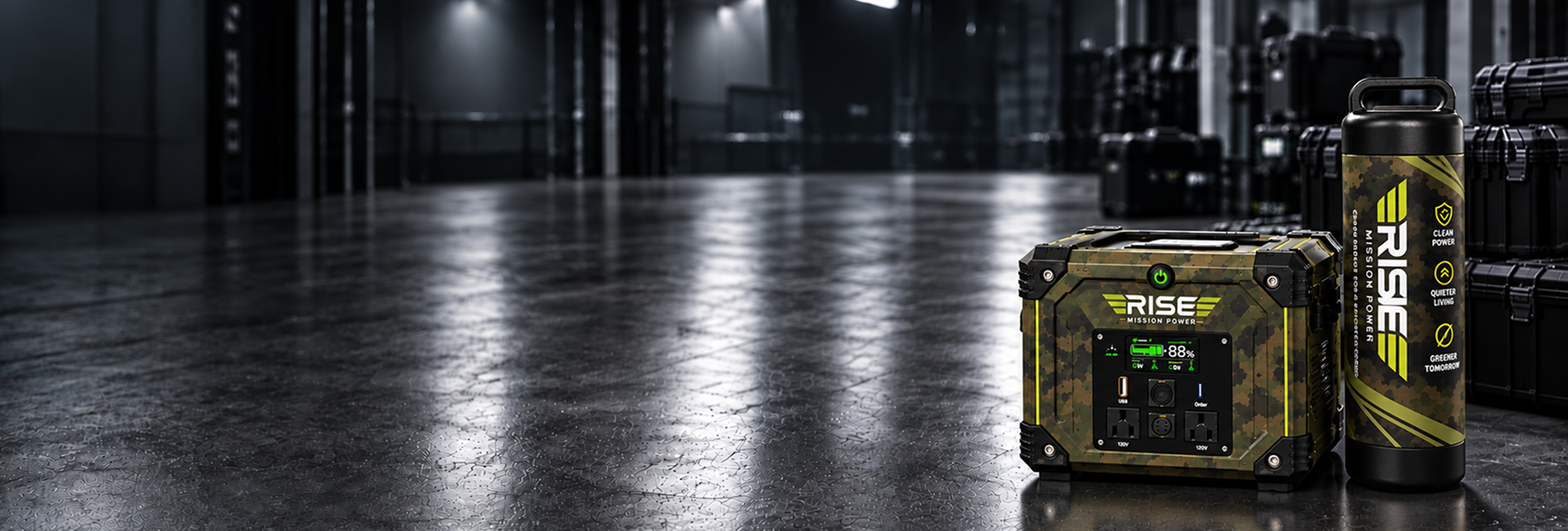
Rise Power's lightweight Rise-Sentinel Power Cube provides extended runtime via cartridge swap. A soldier carrying two cartridges has more energy available than 20 lbs of lithium batteries, at less total weight.
Squad/Platoon Level
Squad-level power requirements include communications relays, ISR drones, electronic warfare systems, and collective equipment charging.
Company/FOB Level
Forward operating bases need sustained power for communications, command and control, lighting, environmental control, medical support, and perimeter security.
The Rise-Titan 1.5 kW generator provides silent, zero-emission power for FOB operations. Operating at under 70 dB, it eliminates the acoustic signature that diesel generators project. Zero exhaust means zero thermal signature from the power source.
Multiple Rise-Titan units can operate in parallel for higher power demands. Combined with solar panels and battery storage, a hybrid microgrid eliminates diesel dependency entirely for small FOBs.
Operational Security Through Silent Power
Acoustic and thermal detection are primary threats. A standard diesel generator at 85 dBA is audible at 500+ meters in quiet conditions. Thermal exhaust is visible on FLIR at significant distances.
Sound Comparison
The difference between 85 dBA and 65 dBA is not incremental. Every 10 dB reduction halves perceived loudness. A fuel cell is roughly 75% quieter than a diesel generator to the human ear, and even more significant for acoustic detection systems.
Thermal Signature
Diesel generators produce hot exhaust gases at 300-600C. This is a beacon on thermal imaging. Hydrogen fuel cells operate at 60-80C with no concentrated exhaust plume. The thermal signature blends into ambient background, making fuel-cell-powered positions dramatically harder to identify.
Power Planning Integration
Effective tactical power management requires integrating fuel cell capability into operational planning:
Allied Adoption
NATO members are actively evaluating and fielding hydrogen fuel cell power systems:
Rise Power is positioned to support allied interoperability through standardized hydrogen cartridge systems. Explore our defence capabilities.
- 01
United States - Army Research Lab programs for soldier-portable fuel cells and UAS propulsion
- 02
United Kingdom - MOD clean energy initiative for forward operating bases
- 03
Germany - Bundeswehr portable fuel cell evaluations
- 04
Australia - Defence Science and Technology Group hydrogen power research
- 05
Canada - DND innovation programs for clean military energy
FAQ
How do hydrogen cartridges integrate with existing military logistics?
Hydrogen cartridges are compact, lightweight, and have a 15-year shelf life. They ship and store like ammunition, fitting into existing supply chain infrastructure. RFID tracking provides the same inventory visibility as other serialized equipment.
Can fuel cells power military vehicles?
Current portable fuel cell technology is best suited for dismounted operations, small UAS, and FOB power. Vehicle propulsion requires higher power levels that are being addressed by next-generation fuel cell systems.
What happens if a hydrogen cartridge is hit by gunfire?
Hydrogen cartridges are designed with safety as a priority. Unlike diesel fuel, which pools and burns, hydrogen gas disperses rapidly upward. A punctured cartridge vents hydrogen that dissipates within seconds rather than creating a sustained fire.
How does power management change with fuel cells versus batteries?
Fuel cells provide continuous power for extended durations, eliminating the charge/swap cycle that batteries require. Power management shifts from rationing limited battery capacity to sustained operations planning. This changes tactical options significantly.
Are fuel cell power systems classified or restricted?
Rise Power's commercial fuel cell systems are available to qualified defence customers. Contact Rise Power for information on procurement, evaluation units, and security classification of specific system configurations.
Related