
TechnologyJun 25, 2025
How Long Do Hydrogen Fuel Cells Last?
Hydrogen fuel cells last 5,000 to 40,000+ hours depending on type and application. Here is what determines lifespan and how to maximize it.
4 min read
Fuel Cell Lifespan: 5,000 to 40,000+ Hours
The short answer is that modern PEM hydrogen fuel cells last between 5,000 and 40,000 hours of operation, depending on the technology, duty cycle, and operating conditions. For a portable unit running 8 hours a day, that is 2 to 14 years of service life.
This compares favorably to diesel generators, which typically require major overhauls every 10,000-15,000 hours and full replacement at 20,000-30,000 hours.
Lifespan by Fuel Cell Type
Different fuel cell technologies have different longevity profiles.
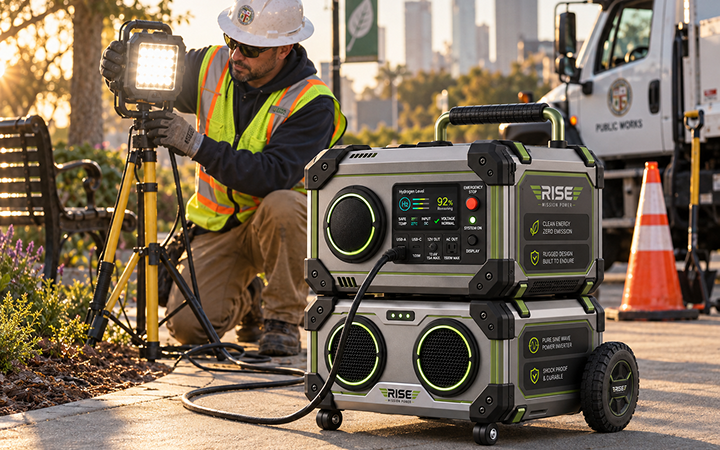
PEM (Proton Exchange Membrane) fuel cells are the dominant technology for portable and deployable power. Rise Power's Rise-Sentinel, Rise-Falcon, and Rise-Titan all use PEM technology, optimized for the specific demands of each application.
What Determines Fuel Cell Lifespan
Membrane Degradation
The PEM membrane is the core component. Over time, it thins and develops micro-pinholes that allow hydrogen crossover. This is the primary aging mechanism.
Factors that accelerate membrane degradation:
Catalyst Degradation
Platinum catalyst particles on the membrane gradually agglomerate (clump together), reducing active surface area. This is a slow, predictable process that manifests as gradual voltage decline.
Load Cycling
Frequent start-stop cycles and rapid load changes stress the membrane more than steady-state operation. A fuel cell running at constant 70% load will outlast one that cycles between 10% and 100% repeatedly.
Environmental Conditions
Salt air, sand, extreme humidity, and temperature swings all affect auxiliary components (fans, pumps, electronics) more than the stack itself. Robust enclosure design mitigates these factors. The Rise-Titan is engineered for operation from −22°C to +50°C, covering virtually all deployment environments.
How Degradation Manifests
Fuel cell aging is gradual, not sudden. You will not wake up to a dead unit. Instead, you will see:
Most systems include diagnostics that track these trends. When output drops below a threshold (typically 80% of rated power), the stack is due for replacement or refurbishment.
- 01
Voltage decline - Typically 1-2% per 1,000 hours of operation for portable PEM systems
- 02
Reduced peak power - The system still runs but cannot hit maximum rated output
- 03
Lower efficiency - More hydrogen consumed per kWh produced
- 04
Longer startup times - Subtle increase in time to reach full operating temperature
Maximizing Fuel Cell Lifespan
Five practices extend service life:
Fuel Cell vs Diesel Generator Longevity
The fuel cell advantage is not just total hours. It is the quality of those hours. Less maintenance, fewer unplanned outages, and predictable end-of-life behavior.
End-of-Life and Sustainability
When a fuel cell stack reaches end of life, the platinum catalyst and membrane materials can be recycled. Platinum recovery rates exceed 95%. This contrasts with diesel generators, where worn engines become scrap with limited material recovery value.
Rise Power designs its systems for stack replaceability. When a stack reaches end of life, the balance of plant (housing, electronics, controls) continues in service with a replacement stack.
FAQ
Can a fuel cell stack be refurbished?
Yes. Stack refurbishment involves replacing the membrane electrode assemblies (MEAs) while reusing the bipolar plates and hardware. This costs significantly less than a full replacement and extends the system's useful life.
How do I monitor fuel cell health in the field?
Modern fuel cells include onboard diagnostics that track cell voltages, output current, and efficiency metrics. Trends over time indicate membrane condition. Some systems support remote monitoring via cellular or satellite links.
Does intermittent use shorten fuel cell life?
Frequent start-stop cycles do cause more degradation per operating hour than steady-state use. For applications like drone range extension where the duty cycle is inherently intermittent, system designers account for this in the durability specifications.
What is the warranty on Rise Power fuel cells?
Contact Rise Power for current warranty terms. Warranties are structured around operating hours and calendar time, reflecting the dual nature of fuel cell aging.
How does altitude affect fuel cell lifespan?
Higher altitudes mean lower oxygen partial pressure, which can reduce peak power output. This does not significantly affect lifespan but may require system derating above certain altitudes. Rise Power systems are tested for operation at altitude.
Related