
ApplicationsJul 12, 2025
Emergency Backup Power for Hospitals
Hospitals need backup power that starts instantly, runs clean, and works indoors. Hydrogen fuel cells deliver where diesel generators fall short.
5 min read
When Hospital Power Fails, People Die
Backup power at hospitals is not a convenience. It is a life-safety system. Ventilators, cardiac monitors, surgical lighting, blood storage, medication refrigeration, and electronic health records all depend on uninterrupted electricity.
Most hospitals rely on diesel generators for emergency backup. These systems work, but they carry serious limitations that hydrogen fuel cells now solve: toxic exhaust preventing indoor placement, noise disrupting patient care, fuel degradation during storage, and cold-weather starting failures.
The Problem with Diesel Backup Power in Healthcare
Diesel generators have been the default for decades. They are well-understood. But well-understood does not mean well-suited.
Real Consequences
During Hurricane Maria in Puerto Rico, hospitals lost generator power when diesel fuel ran out and resupply was impossible. Patients on ventilators died. Insulin and blood supplies spoiled.
During the 2021 Texas freeze, diesel generators at multiple healthcare facilities failed to start because fuel had gelled and block heaters had lost power during the grid outage.
These are not edge cases. They are the scenarios backup power exists to address.
How Hydrogen Fuel Cells Solve Hospital Backup Power
Indoor Installation
Because hydrogen fuel cells emit only warm air and water vapor, they can be installed inside the building, close to critical loads. No exhaust stacks. No outdoor generator pads exposed to weather and vandalism. No long cable runs that add failure points.
Instant Availability
Fuel cell systems deliver power within seconds of activation. There is no engine to crank, no warmup period, no need for block heaters in cold climates.
Extended Runtime Without Resupply
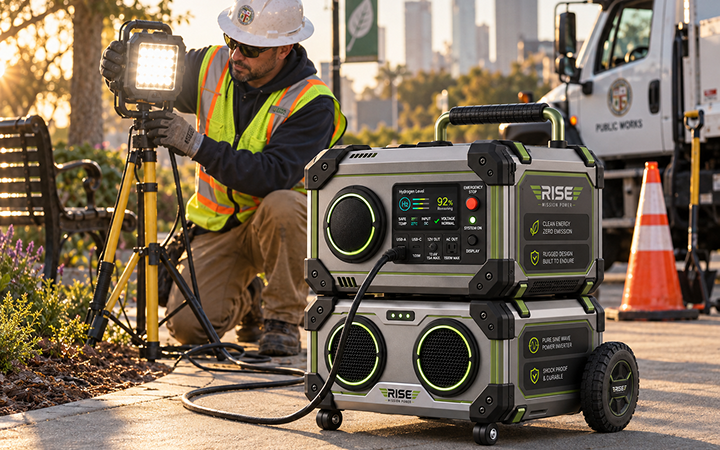
Rise Power's Hydrogen Cartridge Kit enables rapid refueling by swapping cartridges. A hospital can stockpile cartridges for weeks of runtime in the same space a diesel tank would occupy, with the cartridges remaining viable for 15 years.
Scalable Architecture
Multiple fuel cell units can be deployed in parallel. Start with backup for the ICU and surgical suites. Add units for imaging, pharmacy, and administrative systems. The Rise-Titan 1.5 kW generator operates from −22°C to +50°C, and multiple units can be combined for higher power requirements.
Deployment Scenarios
Emergency Department
The ED cannot go dark. Trauma bays, resuscitation rooms, and triage areas need uninterrupted power. A fuel cell system installed in a utility closet adjacent to the ED provides immediate, clean backup without the exhaust routing a diesel generator requires.
Surgical Suites
Mid-procedure power loss is a patient safety crisis. Fuel cells provide seamless backup with no noise increase that would disrupt surgical team communication.
Pharmacy and Lab
Temperature-sensitive medications and lab samples require continuous refrigeration. Fuel cell backup keeps cold storage running during extended outages when diesel resupply may be impossible.
Field Hospitals and Mobile Medical Units
Disaster response medical facilities often operate in tents or temporary structures where diesel exhaust is not an option. The Rise-Sentinel's compact Power Cube provides clean, quiet power for mobile medical equipment.
Regulatory Landscape
Healthcare facility codes (NFPA 110, Joint Commission) mandate specific backup power performance standards. Hydrogen fuel cells meet these requirements and in many cases exceed them.
As emissions regulations tighten globally, hospitals using diesel backup will face increasing compliance costs. Hydrogen fuel cells are future-proof against these regulations.
Getting Started
Transitioning hospital backup power does not have to be all-or-nothing. A phased approach works:
Contact Rise Power for a facility assessment and pilot program proposal tailored to your hospital's critical load requirements.
- 01
Pilot - Deploy fuel cells for a single critical department (ICU, ED, or surgical suite)
- 02
Evaluate - Measure performance, maintenance burden, and staff feedback over 6-12 months
- 03
Expand - Roll out to additional departments based on pilot results
- 04
Optimize - Right-size hydrogen cartridge inventory based on actual consumption data
FAQ
Do hydrogen fuel cells meet hospital backup power codes?
Yes. Hydrogen fuel cells meet NFPA 110 and Joint Commission requirements for emergency power systems. They deliver power within seconds and can be configured for 96+ hours of runtime with adequate cartridge inventory.
Can fuel cells handle the full electrical load of a hospital?
Current portable fuel cell technology is best suited for critical subsystems rather than whole-building backup. They complement existing infrastructure by providing clean, reliable power for life-safety loads. Larger installations can combine multiple units.
What happens if hydrogen cartridges run out during an extended outage?
Cartridge swaps take seconds. With proper pre-positioning, a hospital can maintain weeks of backup power. Unlike diesel, hydrogen cartridges do not degrade during storage, so maintaining a large inventory carries no fuel quality risk.
Is hydrogen storage safe inside a hospital?
Hydrogen cartridges are sealed, pressure-rated containers designed for safe indoor storage. They meet DOT transport standards. Hydrogen gas is lighter than air and disperses rapidly if released, unlike gasoline or diesel fumes that accumulate at floor level.
How does the cost compare to diesel backup systems?
Upfront cost for fuel cells is currently higher than diesel generators. However, total cost of ownership is competitive when you factor in fuel shelf life (no diesel replacement every 12 months), minimal maintenance, and avoided emissions compliance costs. Request a TCO comparison for your facility.
Related