
DefenceMay 22, 2025
Extending Military Drone Endurance with Fuel Cells
Hydrogen fuel cells give drones up to 5x extended flight range over batteries. Here is how fuel cell propulsion changes ISR operations.
6 min read
Battery-Powered Drones Hit a Wall at 45 Minutes
The single biggest limitation of military UAS (Unmanned Aerial Systems) is endurance. Most battery-powered tactical drones fly 20-45 minutes before they need to land, swap batteries, and relaunch. That gap in coverage is an operational vulnerability.
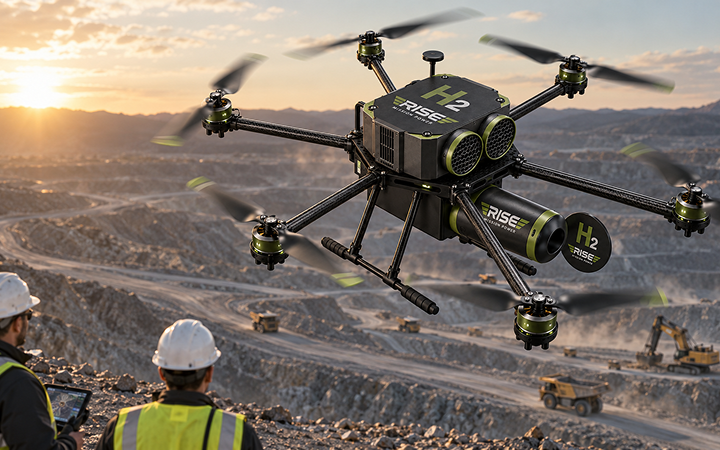
Hydrogen fuel cell propulsion shatters this limitation. Rise Power's Rise-Falcon drone range extender delivers up to 5x extended flight range over equivalent battery systems. For ISR (Intelligence, Surveillance, and Reconnaissance) missions, that means continuous coverage instead of scheduled gaps.
Why Batteries Cannot Solve the Endurance Problem
Lithium-polymer batteries have improved steadily over the past decade. But they are approaching theoretical energy density limits. The physics are clear:
Even doubling battery energy density (which would require a fundamental chemistry breakthrough) would still leave batteries far behind hydrogen for endurance applications.
Adding more batteries to extend range creates a vicious cycle: more battery weight demands more lift, which consumes more power, which shortens range gains. At some point, additional batteries add zero net flight time.
How Fuel Cell Propulsion Works in Drones
The Rise-Falcon integrates a PEM fuel cell stack with lightweight hydrogen storage. The fuel cell converts hydrogen and ambient air into electricity, which powers the drone's electric motors directly.
System Architecture
The hybrid fuel cell + buffer battery architecture is critical. The fuel cell provides steady baseload power for cruise flight, while the battery handles transient peak demands. This optimizes both endurance and maneuverability.
- 01
Fuel cell stack - Generates electricity from hydrogen
- 02
Hydrogen storage - Lightweight compressed or chemical hydride cartridge
- 03
Power management - Regulates output to motors and avionics
- 04
Battery buffer - Small lithium battery handles peak loads during maneuvers (takeoff, climb, evasion)
- 05
Thermal management - Waste heat dissipated through airflow
Operational Impact: ISR Mission Comparison
For a border surveillance mission requiring 8 hours of continuous coverage, a battery drone needs 10-20 launch/recovery cycles with coverage gaps during each swap. A fuel cell drone covers the same mission with 1-2 cycles and near-continuous coverage.
Tactical Advantages Beyond Endurance
Reduced Logistics Footprint
A squad carrying hydrogen cartridges for 72 hours of drone operations packs lighter than the equivalent battery load. Hydrogen's superior energy density translates directly to reduced logistics burden in dismounted operations.
Cold Weather Reliability
Battery capacity drops 20-40% in cold weather. This is not a marginal concern when operating in arctic or high-altitude environments. Fuel cell output remains stable across the temperature range. The Rise-Falcon maintains full performance in conditions that would ground a battery drone.
Silent Approach
The fuel cell itself produces no noise. The only acoustic signature is the propeller and motor noise, identical to a battery drone. There is no combustion engine noise to increase detection range. Combined with zero thermal exhaust signature, fuel cell drones are exceptionally difficult to detect.
Rapid Refueling
Swapping a hydrogen cartridge takes seconds. Recharging a battery takes 30-90 minutes. In a dynamic tactical environment, the ability to rearm a drone in under a minute versus waiting an hour for battery charge is a decisive advantage.
Integration Considerations
Weight Budget
The Rise-Falcon is designed to integrate with compatible UAS platforms. The fuel cell system replaces battery weight, so the airframe does not need structural modification in most cases. Net weight change is typically neutral or slightly favorable.
Airframe Compatibility
Fuel cell propulsion works with both fixed-wing and multirotor platforms. Fixed-wing designs benefit most because cruise flight at steady power plays to the fuel cell's strength. Multirotor platforms still see significant endurance gains, though the improvement ratio is somewhat lower due to higher hover power demands.
Hydrogen Logistics
Rise Power's Hydrogen Cartridge Kit standardizes fuel logistics. RFID-tagged cartridges integrate with existing supply chain tracking systems. With a 15-year shelf life, cartridges can be pre-positioned at forward operating bases, patrol bases, and supply depots without degradation concerns.
Future Developments
Fuel cell drone technology is advancing on several fronts:
NATO and allied defence agencies have identified hydrogen fuel cell UAS as a priority capability for 2025-2030 procurement cycles. Learn about Rise Power's defence solutions.
- 01
Higher power density stacks enabling heavier payloads
- 02
Solid-state hydrogen storage reducing cartridge volume
- 03
Hybrid fuel cell/solar for ultra-endurance surveillance platforms
- 04
Swarm coordination leveraging extended endurance for persistent multi-drone operations
FAQ
Does a fuel cell add significant weight to a drone?
The fuel cell system replaces batteries, so the weight trade is often neutral. For a given endurance target, the fuel cell system is actually lighter than the battery pack that would be needed.
Can fuel cell drones operate in rain?
Yes. PEM fuel cells are sealed systems. The Rise-Falcon is designed for operation in adverse weather conditions consistent with military requirements.
What altitude limitations exist for fuel cell drones?
Higher altitudes reduce oxygen availability, which can affect fuel cell output. Most tactical UAS operations below 15,000 feet AGL see negligible impact. Systems can be optimized for high-altitude operation if required.
How does fuel cell drone endurance compare to gas-powered drones?
Gas-powered drones offer similar endurance but produce significant noise and thermal signatures. Fuel cell drones match the endurance while maintaining the stealth characteristics of electric propulsion. See our full technology comparison.
Are hydrogen cartridges classified as hazardous material for air transport?
Hydrogen cartridges are classified as compressed gas and have specific transport regulations. Rise Power cartridges are designed and certified for safe transport, including air shipment under applicable DOT and IATA regulations.
Related