
ComparisonDec 10, 2025
Generator Noise Levels: Why dBA Matters
Generator noise isn't just annoying -- it's a tactical and operational liability. Compare noise levels across generator types and learn why dBA matters.
4 min read
Noise Kills Missions and Operations
A generator running at 85 dBA can be heard from 200 meters away. In a military context, that's a position reveal. In a disaster response camp, that's sleep deprivation for survivors. In a film set or outdoor event, that's a ruined take or a noise complaint. Generator noise level is one of the most underweighted factors in portable power selection.
This guide breaks down what dBA actually means, how generator types compare, and why the difference between 65 dBA and 85 dBA is far larger than the numbers suggest.
Understanding dBA
The decibel scale is logarithmic, not linear. That means small number changes represent large real-world differences:
So a generator rated at 85 dBA isn't slightly louder than one rated at 65 dBA. It sounds roughly four times louder and produces 100 times more sound energy.
- 01
A 3 dBA increase means the sound energy has doubled
- 02
A 10 dBA increase sounds roughly twice as loud to human ears
- 03
A 20 dBA increase sounds four times as loud
Common Sound Level References
Noise Comparison by Generator Type
Why Noise Matters Beyond Comfort
Military and Defence
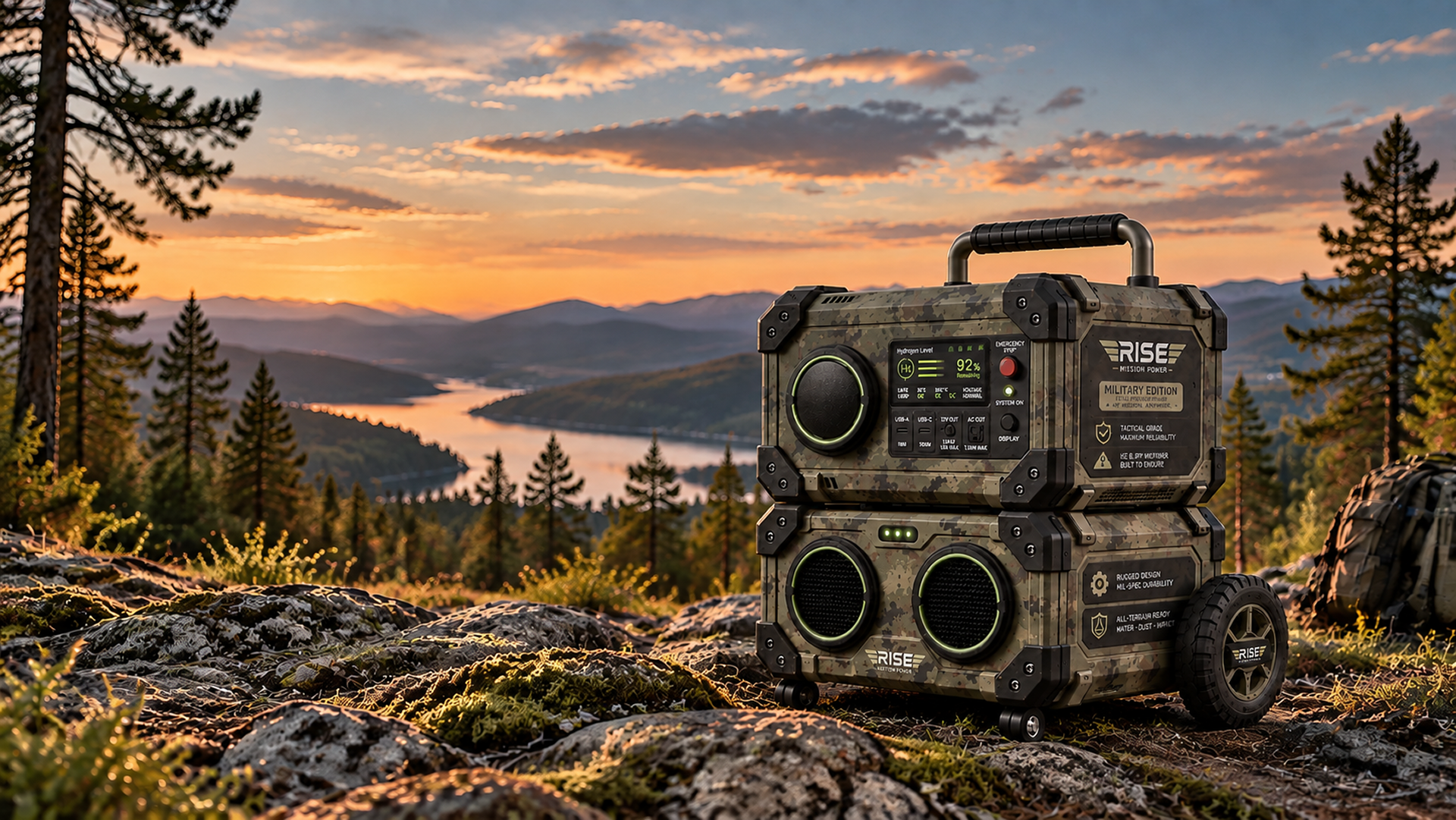
NATO standards classify noise discipline levels for different operational environments. A generator producing 85+ dBA violates noise discipline in most tactical scenarios. The Rise-Sentinel fuel cell operates under 65 dBA, enabling powered operations during noise-restricted phases.
Acoustic detection systems used by adversaries can identify and locate generator noise at distances over 500 meters. Infrared combined with acoustic signatures make conventional generators high-value targets in contested environments.
Emergency Response
FEMA and emergency management agencies set noise limits in disaster shelters. Sustained exposure to 85+ dBA causes hearing damage over 8 hours. First responders and survivors in temporary camps need quiet power for medical operations, communications, and rest.
Construction and Events
Most municipalities enforce noise ordinances between 65-75 dBA at property lines. A diesel generator running at 85 dBA at 7 meters will exceed those limits at distances under 50 meters. Hydrogen fuel cells and inverter generators both meet typical noise ordinances.
The Distance Factor
Sound decreases by approximately 6 dBA each time you double the distance from the source (in open air). Here's how a 65 dBA fuel cell compares to an 85 dBA diesel generator at various distances:
At 100 meters, the hydrogen fuel cell is essentially inaudible against ambient outdoor noise (typically 35-45 dBA). The diesel generator is still clearly audible.
Noise Characteristics Beyond Volume
Raw dBA doesn't capture everything. The character of the noise also matters:
What "Quiet" Really Costs with Diesel
Diesel generator manufacturers sell "quiet" or "silenced" models with acoustic enclosures. These reduce noise by 10-20 dBA but add 30-50% to weight and cost. A silenced diesel generator producing 65 dBA weighs 2-3x more than a hydrogen fuel cell at the same noise level and power output. See our full generator comparison.
FAQ
What's the quietest generator technology available?
Solar-plus-battery systems produce almost zero noise. Among fuel-based generators, hydrogen fuel cells are the quietest, typically under 65 dBA at 1 meter. Rise Power's products operate below 70 dBA across the full product line.
Do noise levels change with load?
Yes. Most generators are louder at full load than partial load. Inverter generators and hydrogen fuel cells handle this better than conventional generators because they modulate output electronically rather than mechanically.
How is generator noise measured?
Manufacturers measure noise at 7 meters (23 feet) from the generator at rated load, per ISO 8528-10. Always check whether a spec is measured at 1m or 7m -- the difference is roughly 17 dBA. A generator listed as "57 dBA" at 7m is about 74 dBA at 1m.
Can you run a hydrogen fuel cell inside a tent or building?
Yes. Unlike combustion generators, hydrogen fuel cells emit only water vapor and warm air. There's no carbon monoxide risk. This enables indoor operation where noise is further reduced by building walls.
Does cold weather affect fuel cell noise levels?
Slightly. Cooling fans may run less in cold conditions, marginally reducing noise. Overall, hydrogen fuel cell noise levels remain consistent across the operating range of −22°C to +50°C.
Related